|
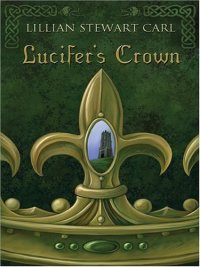
Lucifer's Crown begins when a
young woman finds a dead body in the ruins of Glastonbury Abbey in England, on
the morning of All Saint's Day. Another body turns up later on in the book, so
it's a mystery novel, right? But wait -- both Rose and her older, more cynical
teacher, Maggie, each find romance--in very different sorts of ways--so it's a
romance novel, too. Also, two characters in Lucifer's Crown are immortal, and
Maggie, Rose, and the others encounter paranormal events and places.
Lucifer's Crown plays out in
England and Scotland over the two months between Halloween and New Year's Eve of
the year 2000. The characters must race to achieve a task before the turning of
the millennium. Of course it's not easy for them--if it were, I'd have no story.
They must make difficult choices, and are often tempted away from their path by
their opponents, who are clever and devious enough to play to their weaknesses.
The story is set at real places: Glastonbury, Canterbury, Salisbury in England,
the Eildon Hills, Fortingall, Edinburgh in Scotland. The legends and history
the characters encounter are for real. All I do is show how intricately the
stories are interwoven.
This is the "big" book I always
wanted to write. I started it in 1995, and took it through many different
versions before publication. I've always been intrigued by the way the past
lingers on into the present, how history and fantasy (legend and myth) affect
our views of reality. Obviously I mean "fantasy" as a positive force, not in the
disparaging meaning of "lies", as though fantasy exists only for immoral
purposes!
All my books explore this
tension between past and present, fantasy and reality. It's in Lucifer's Crown I
bring out the heavy artillery, the Arthurian legends and the stories of the Holy
Grail. The origins of, and the truth behind, these legends have fascinated me
since childhood, probably because they're such universal tales of heroism and
redemption.
The background material for
Lucifer's Crown is taken from material I've been reading my entire life.
Specifically for the book, I spent hours walking around Canterbury Cathedral,
notebook in hand. I bought several books about the archaeology of Glastonbury at
the Abbey book shop--and then picked up some "alternative" booklets at a New Age
bookstore across the street.
I couldn't begin to pick out
one of the thousands of little bits and pieces of information I collected--very
few of which actually make it into the book--but I can recommend one book that
really got me to thinking. It's Avalonian Quest by Geoffrey Ashe, about
Glastonbury and how the legends surrounding it tie in to its reality. His
description of the labyrinthine design of the terraces on Glastonbury Tor was
invaluable to me for the chapter where the characters actually trace that
labyrinth around the Tor.
I refer to Robin, the villain,
as "a polished devil". In his first, original life he was Robert the Devil, the
father of William the Conqueror, who killed his brother for power and wealth. In
my story, he then sold his soul to the devil for more. He's smooth and
handsome, a seducer in every sense of the word, who manipulates people to
empower himself. He simply cannot see outside his own ego.
Oddly enough, in the first
draft of the book, the villain was just a demon named Robin. Then I decided that
if I was using one historical character as my protagonist, I should have another
as my antagonist--and I literally stumbled over Robert the Devil when I was
looking up something else! (Twilight Zone music here)
As for Thomas Becket, known
historically as "England's greatest saint", his story fascinates me. He must
have been an enormously intelligent and ambitious man. In Lucifer's Crown he
isn't murdered in 1170. In a moment of cowardice he allowed another man to take
his place. That man was canonized in Thomas's name, something he's kept secret
until now. I refer to him as "a tarnished saint", because he's been struggling
to atone for his crime and learn humility for 800 years and still wonders if he
can ever overcome his own pride and accept forgiveness. I thought it was only
fair to let him have an offbeat sort of romance, after all those years of living
alone. |